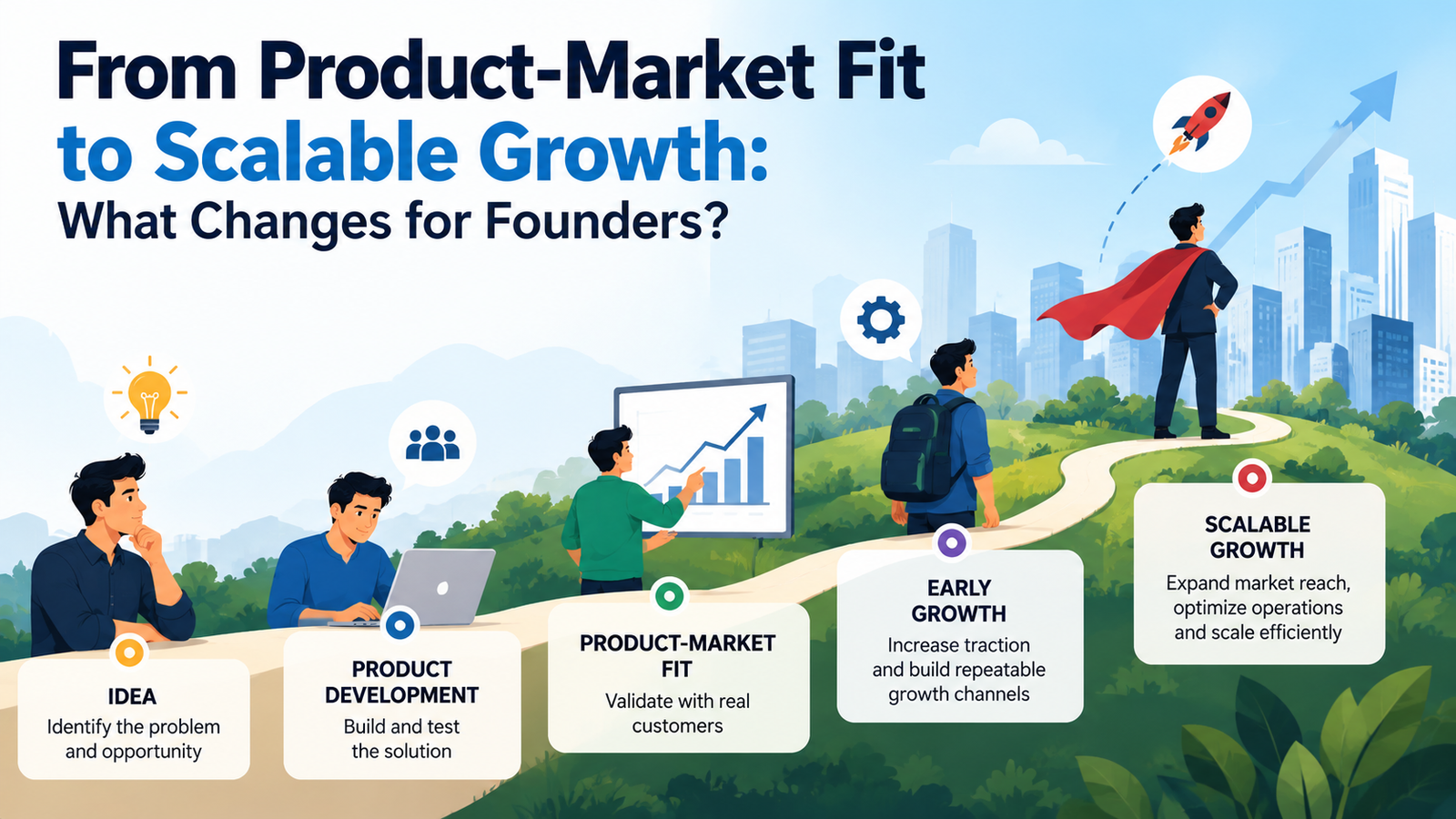
Building a startup is a journey of constant learning and adaptation. In the early stages, founders focus on identifying a problem, developing a solution, and finding customers willing to pay for it. But once the business begins gaining traction, the priorities change.
Moving from product-market fit to scalable growth requires more than acquiring additional customers. It demands stronger processes, better financial planning, effective leadership, and a business model that can support expansion without increasing costs at the same rate.
For founders, understanding this transition is essential to building a sustainable business that attracts investors and creates long-term value.
What Is Product-Market Fit?
Product-market fit occurs when a product effectively solves a meaningful customer problem and generates consistent demand from its target audience.
At this stage, customers recognize the product’s value, use it regularly, and are willing to pay for it. The startup begins to see evidence that its offering meets a genuine market need.
Founders can look for several indicators of product-market fit:
- Consistent customer acquisition and engagement.
- Strong retention and repeat purchases.
- Positive customer feedback and referrals.
- Increasing willingness to pay.
- A clear understanding of the target audience.
- Evidence that customers would be disappointed if the product disappeared.
Product-market fit is not a single milestone that guarantees success. It is an evolving process that requires continuous validation as customer needs and market conditions change.
1. The Founder’s Focus Shifts From Experimentation to Execution
Before product-market fit, founders typically experiment with product features, pricing, target customers, and distribution channels. The objective is to discover what works.
After finding meaningful traction, the focus shifts toward repeating successful activities and improving their efficiency.
Instead of constantly changing the business model, founders must identify which products, customer segments, and acquisition channels deliver the strongest results.
This transition involves:
- Prioritizing features based on customer needs.
- Identifying the most profitable customer segments.
- Standardizing successful sales processes.
- Establishing measurable business goals.
- Reducing unnecessary experimentation.
Experimentation remains important, but it becomes more focused. The objective is to improve a business model that has demonstrated demand rather than repeatedly searching for a viable one.
2. Customer Acquisition Becomes More Systematic
Early-stage startups often acquire customers through personal networks, founder-led sales, referrals, and manual outreach.
These methods can be effective for validating a product, but they may not generate enough customers to support substantial growth.
As the business scales, founders need repeatable customer acquisition channels.
Depending on the business model, these might include:
- Search engine optimization and content marketing.
- Paid advertising.
- Partnerships and referral programs.
- Inside sales and enterprise sales teams.
- Product-led growth.
- Distributor or reseller networks.
The key is to understand the economics of each channel.
Founders should track customer acquisition cost (CAC), conversion rates, sales cycle length, and customer lifetime value (LTV). These metrics help determine whether growth can continue without consuming excessive capital.
A channel that generates customers quickly is not necessarily the best choice if acquisition costs exceed the value those customers generate.
3. Financial Management Becomes More Important
When a startup is small, founders may manage finances informally. As revenue, hiring, and operating expenses increase, this approach becomes risky.
Scaling requires greater financial discipline and visibility.
Founders should develop reliable systems for monitoring:
- Revenue and gross margins.
- Operating expenses.
- Cash flow and working capital.
- Customer acquisition costs.
- Monthly burn rate and cash runway.
- Revenue forecasts and budget variances.
Financial planning helps founders understand how much growth they can afford and when additional capital may be necessary.
For example, a startup may experience rapid revenue growth while simultaneously facing rising acquisition costs, longer payment cycles, and increasing payroll expenses. Without careful cash-flow management, this growth can create financial pressure.
The objective is not simply to increase revenue but to build a business that can support expansion financially.
4. Teams and Leadership Structures Must Evolve
In the early stages, founders often handle product development, sales, customer support, marketing, and operations themselves.
This hands-on approach helps startups move quickly, but it becomes difficult to maintain as the company grows.
Founders must gradually move from managing individual tasks to building teams that can operate independently.
This transition includes:
- Hiring people for clearly defined roles.
- Establishing responsibilities and reporting structures.
- Creating performance measures.
- Delegating operational decisions.
- Developing management capabilities.
- Building a culture of accountability.
Hiring too quickly can increase costs and create unnecessary complexity. Hiring too slowly can limit growth and overwhelm existing employees.
Successful scaling requires identifying the capabilities the business needs next and hiring accordingly.
5. Processes Become Essential for Consistency
Informal processes can work when a startup has only a few employees and customers. As volume increases, relying on individual knowledge and manual coordination becomes less effective.
Repeatable processes help ensure that the business can deliver consistent results as it grows.
Founders should consider documenting and improving workflows for:
- Customer onboarding.
- Sales qualification and follow-ups.
- Product development and quality assurance.
- Customer support and complaint resolution.
- Billing and collections.
- Recruitment and employee onboarding.
- Reporting and performance reviews.
Automation can further reduce repetitive work, but processes should be understood and improved before they are automated.
The goal is to build an operating model that supports more customers without requiring proportionally more manual effort for every transaction.
6. Product Development Shifts Toward Reliability and Scalability
During product validation, speed is often the priority. Founders need to build, test, and improve their offerings quickly.
As usage increases, product reliability, security, performance, and customer experience become increasingly important.
A product that works for 100 customers may encounter technical or operational challenges when serving 10,000 customers.
Depending on the business, founders may need to invest in:
- Scalable infrastructure.
- Automated testing.
- Monitoring and incident response.
- Data security and access controls.
- Customer support systems.
- Product analytics.
- Technical documentation.
These investments help reduce outages, operational bottlenecks, and costly rework.
Founders should avoid overengineering too early, but they must address technical limitations before those limitations become barriers to growth.
7. Customer Retention Becomes a Growth Priority
Acquiring customers is only one part of building a scalable business. Retaining them is equally important.
If customers leave quickly, the company may need to spend continually on acquisition just to maintain its existing revenue.
Founders should monitor retention rates, churn, repeat purchases, customer satisfaction, and product engagement.
They should also investigate why customers leave.
Common reasons include poor onboarding, missing features, inadequate support, weak product value, and changing customer needs.
Improving retention can strengthen revenue predictability and make customer acquisition investments more productive.
For subscription businesses, better retention can have a particularly significant effect on lifetime value and long-term profitability.
8. Growth Decisions Become More Data-Driven
In an early-stage startup, founders often rely on direct customer conversations and personal judgment. These remain valuable, but scaling introduces more complexity than intuition alone can reliably manage.
Founders need a clear set of metrics that connects daily activities with business outcomes.
Useful measures include:
- Monthly recurring revenue (MRR), where applicable.
- Revenue growth rate.
- Gross profit margin.
- CAC and LTV.
- Customer retention and churn.
- Sales conversion rates.
- Revenue per employee.
- Operating cash flow.
The right metrics depend on the company’s business model and stage.
For example, an e-commerce startup may focus heavily on contribution margin, repeat purchase rate, inventory turnover, and fulfillment costs. A SaaS company may place greater emphasis on recurring revenue, retention, expansion revenue, and customer acquisition payback.
The purpose of measurement is to identify bottlenecks, evaluate decisions, and improve performance—not to track every possible number.
9. Investors Expect a Clearer Growth Strategy
Investors evaluating an early-stage startup may accept uncertainty while the founders validate the product and market.
Once the startup demonstrates meaningful product-market fit, investors typically want to understand how the company will turn that traction into repeatable growth.
They may examine:
- The size and accessibility of the target market.
- Evidence of customer demand.
- The effectiveness of acquisition channels.
- Revenue growth and retention.
- Unit economics.
- Competitive advantages.
- Hiring and capital requirements.
- The potential to expand into new markets.
Founders should be able to explain how additional capital will support specific growth initiatives and what measurable outcomes they expect.
A credible growth plan connects market opportunity with execution capability. It does not rely solely on ambitious revenue projections.
10. Founders Must Balance Growth With Profitability
Rapid expansion can be attractive, but pursuing growth at any cost can weaken a startup’s financial position.
As the company scales, founders need to understand which investments generate sustainable returns.
This means evaluating marketing expenditure, hiring decisions, infrastructure costs, pricing, and new product development against their expected business impact.
A useful approach is to assess major initiatives based on three questions:
- Will this investment generate additional revenue, improve retention, or reduce costs?
- How long will it take to produce measurable results?
- Can the business support the investment without creating excessive financial risk?
The balance between growth and profitability varies by industry and business stage. Some startups may rationally prioritize expansion, while others benefit from reaching profitability earlier.
What matters is having a clear strategy supported by reliable financial data.
Common Mistakes Founders Make When Scaling
Even startups with strong customer demand can struggle during the transition to scalable growth.
Some common mistakes include:
Hiring too quickly: Expanding headcount before revenue and operational needs justify it can increase costs unnecessarily.
Expanding into too many markets: Entering new geographies or customer segments before establishing repeatable processes can stretch resources.
Ignoring customer retention: High acquisition numbers can hide problems with product value or customer satisfaction.
Scaling inefficient processes: Automating or expanding a weak workflow can multiply existing problems.
Neglecting cash flow: Revenue growth does not guarantee that the company has enough cash to meet its obligations.
Losing customer focus: Internal complexity can distract founders from the problem the product was designed to solve.
Avoiding these mistakes requires disciplined prioritization, continuous customer feedback, and a willingness to address operational weaknesses before expanding further.
A Practical Checklist for Moving Toward Scalable Growth
Before significantly increasing spending or expanding operations, founders should assess whether they have:
- Evidence of sustained customer demand.
- A clearly defined target customer.
- Reliable customer acquisition channels.
- Understandable and measurable unit economics.
- A realistic financial forecast and cash-flow plan.
- Strong customer retention and onboarding processes.
- Clear team responsibilities and hiring priorities.
- Reliable product infrastructure and quality controls.
- Documented operational workflows.
- A measurable growth strategy with defined milestones.
Not every item needs to be perfect before a startup grows. However, identifying gaps early allows founders to manage risks and allocate resources more effectively.
Final Thoughts
The transition from product-market fit to scalable growth marks a significant change in how founders build and manage their companies.
The early stage is about discovering a product that customers genuinely want. The scaling stage is about developing the people, processes, financial discipline, and distribution systems needed to deliver that value consistently to a larger market.
Founders who make this transition successfully focus on more than customer acquisition. They build repeatable sales channels, retain customers, manage cash carefully, develop capable teams, and invest in infrastructure that supports sustainable expansion.
Product-market fit demonstrates that a business has found demand. Scalable growth demonstrates that it can serve that demand efficiently and consistently.
By understanding the difference and preparing for the operational challenges ahead, founders can improve their chances of building a resilient business that is ready for its next stage of growth.