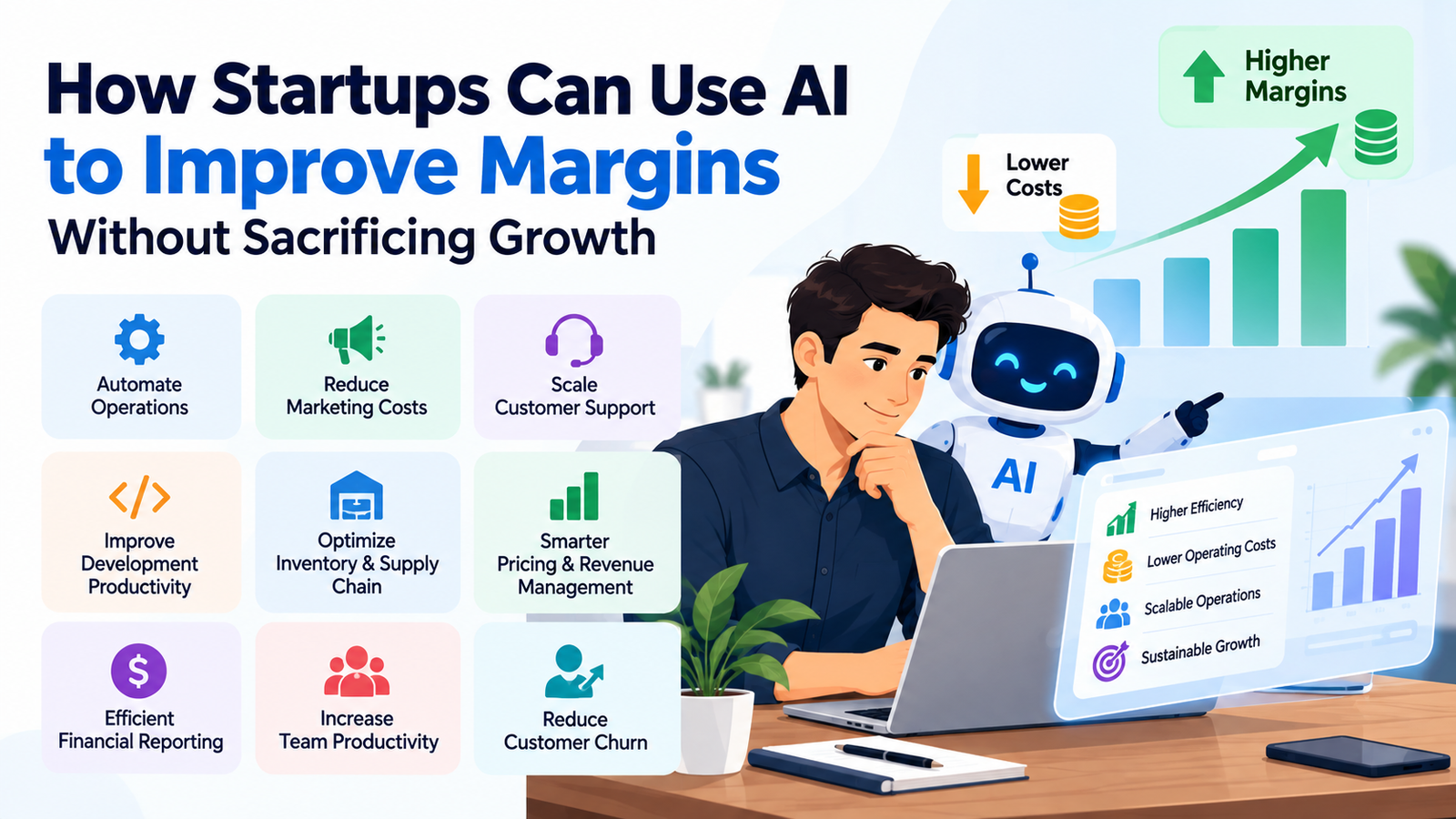
For startups, growth often comes with rising costs. Hiring more employees, increasing marketing budgets, expanding customer support, and managing growing operations can put significant pressure on profit margins. While scaling revenue is important, founders must also ensure that expenses do not increase at the same pace.
Artificial intelligence (AI) offers startups an opportunity to address this challenge. By automating repetitive tasks, improving operational efficiency, and helping teams make better decisions, AI can reduce costs while allowing businesses to serve more customers.
However, the goal should not be to replace every process with AI or cut expenses indiscriminately. The real opportunity lies in using AI strategically to improve profitability while maintaining product quality, customer satisfaction, and sustainable growth.
1. Automate Repetitive Operational Tasks
Many startups spend valuable employee hours on routine activities such as data entry, report generation, appointment scheduling, invoice processing, and internal documentation.
AI-powered tools can automate parts of these workflows, reducing manual effort and allowing employees to focus on higher-value activities.
For example, a SaaS startup can use AI to categorize support tickets, summarize customer conversations, and prepare internal reports. An e-commerce company can automate product descriptions, order-status responses, and inventory alerts.
The financial benefit comes from reducing the time and resources required to complete each task.
Founders should start by identifying processes that are repetitive, time-consuming, and relatively low-risk before introducing automation.
2. Reduce Customer Acquisition Costs With AI
Customer acquisition is one of the largest expenses for many growing startups. AI can help marketing teams allocate budgets more efficiently by identifying customer segments, analyzing campaign performance, and personalizing marketing messages.
Startups can use AI to:
- Analyze advertising performance across campaigns.
- Identify high-converting customer segments.
- Generate and test marketing creatives.
- Personalize email campaigns.
- Predict which leads are more likely to convert.
- Identify opportunities to improve landing-page conversions.
For example, a startup can analyze historical campaign data to determine which customer segments produce the highest conversion rates. Marketing budgets can then be directed toward campaigns with stronger performance.
AI does not guarantee lower acquisition costs, but it can help teams test strategies faster and make better-informed spending decisions.
3. Scale Customer Support Without Proportionally Increasing Headcount
As customer numbers grow, support requests often increase. Hiring additional support staff for every increase in demand can make scaling expensive.
AI chatbots and support assistants can handle routine questions, provide product guidance, retrieve relevant documentation, and route complex issues to human agents.
A practical approach is to automate common questions while allowing employees to handle complaints, sensitive situations, and complicated technical problems.
Startups should monitor resolution rates, customer satisfaction, escalation rates, and response times to ensure automation does not compromise the customer experience.
The objective is to increase the number of customers the support team can serve effectively—not simply to reduce staffing costs.
4. Improve Software Development Productivity
For technology startups, product development can account for a substantial portion of operating expenses.
AI coding assistants can support developers with code generation, test creation, documentation, debugging, and code review. These tools can reduce time spent on routine development activities and help teams move from ideas to working features more efficiently.
Potential applications include:
- Generating unit tests.
- Creating technical documentation.
- Identifying common coding errors.
- Automating repetitive code patterns.
- Assisting with code reviews.
- Supporting legacy-code analysis.
However, AI-generated code still requires human review, security testing, and quality assurance.
Startups should measure whether these tools reduce delivery time and rework rather than assuming that more code produced automatically means greater productivity.
5. Use AI to Improve Inventory and Supply Chain Decisions
For e-commerce, retail, and manufacturing startups, inventory mistakes can tie up cash and reduce margins.
Excess inventory increases storage costs and the risk of unsold stock, while insufficient inventory can lead to lost sales and dissatisfied customers.
AI-assisted forecasting can analyze historical sales, seasonal trends, promotions, and other relevant data to estimate future demand.
Businesses can use these insights to improve purchasing decisions, identify slow-moving products, and plan replenishment more effectively.
Forecasts should be reviewed against actual results, especially when a startup has limited historical data or experiences rapidly changing demand.
6. Improve Pricing and Revenue Management
Pricing decisions have a direct effect on profitability. Setting prices too low can limit margins, while setting them too high can reduce conversion rates or customer retention.
AI can help startups analyze customer behavior, purchasing patterns, competitor information, and product performance to support pricing decisions.
For subscription businesses, AI-assisted analysis can help identify:
- Customer segments with different needs.
- Features that influence upgrades.
- Accounts at risk of cancellation.
- Products with strong or weak margins.
- Opportunities for cross-selling and upselling.
Founders should use these insights alongside customer research and competitive positioning. Pricing decisions should also respect contractual commitments, applicable laws, and customer trust.
7. Make Finance and Reporting More Efficient
Financial visibility becomes increasingly important as a startup grows. Founders need timely information about revenue, expenses, cash flow, and profitability to make sound decisions.
AI-enabled financial tools can assist with transaction categorization, expense analysis, invoice processing, forecasting, and variance reporting.
For example, a startup can compare actual spending against its budget and flag unexpected increases in software subscriptions, marketing costs, or supplier expenses.
These capabilities can help finance teams identify problems earlier and reduce the effort required to prepare reports.
AI-generated financial outputs should still be reviewed for accuracy. Financial records, tax filings, and important accounting decisions require appropriate controls and qualified oversight.
8. Increase Employee Productivity Without Increasing Headcount at the Same Rate
Not every increase in workload requires an immediate increase in hiring.
AI can help existing teams manage more work by assisting with research, drafting, meeting summaries, internal knowledge retrieval, and routine analysis.
For example, a small sales team can use AI to prepare account research, summarize calls, and draft follow-up emails. A marketing team can use AI to create initial content drafts and adapt campaign assets for different channels.
The benefit depends on how effectively these tools fit into existing workflows.
Startups should provide employees with clear guidelines, training, and appropriate review processes. Productivity gains are more likely when AI improves a complete workflow rather than being introduced as an isolated tool.
9. Reduce Customer Churn and Protect Recurring Revenue
Acquiring new customers is often more expensive than retaining existing ones. For subscription-based startups, improving retention can support more predictable revenue and better long-term economics.
AI can analyze customer activity, support interactions, subscription history, and engagement patterns to identify possible signs of churn.
Teams can use these insights to prioritize customer outreach, improve onboarding, and address recurring product issues.
However, churn predictions are not always accurate. Startups should validate them against actual outcomes and avoid using sensitive customer information without appropriate safeguards.
The goal is to identify customers who need help and improve their experience—not to make decisions based on automated predictions alone.
10. Measure AI’s Impact on Profit Margins
Implementing AI is an investment. Startups may incur costs for software subscriptions, model usage, integration, employee training, security, and ongoing maintenance.
Before expanding an AI initiative, founders should measure its financial impact.
Important metrics include:
- Gross margin: Revenue remaining after the direct costs of delivering products or services.
- Operating margin: Operating profit as a percentage of revenue.
- Customer acquisition cost (CAC): The cost of acquiring a new customer.
- Cost to serve: The average cost of delivering a product or service to a customer.
- Revenue per employee: Revenue generated relative to team size.
- Customer retention: The percentage of customers who continue using the product.
- AI cost per task: The total cost of using AI to complete a defined activity.
- Return on investment (ROI): The financial benefit generated relative to the investment.
A useful way to evaluate an AI initiative is to compare its total cost with the measurable savings or additional gross profit it produces.
For instance, if an automation saves employee time but requires expensive integrations and frequent manual corrections, the net benefit may be limited.
11. Avoid Common AI Implementation Mistakes
AI can create new expenses and operational risks when implemented without a clear strategy.
Startups should avoid:
Automating inefficient processes: Improve the workflow before automating it.
Choosing tools without a measurable objective: Every significant AI project should address a defined business problem.
Ignoring data quality: Inaccurate or incomplete data can produce unreliable recommendations.
Underestimating hidden costs: Include integration, maintenance, usage fees, training, and human review.
Removing human oversight too early: Important financial, legal, security, and customer decisions may require human approval.
Measuring activity instead of outcomes: Faster content production or more automated tasks do not necessarily translate into better margins.
Ignoring customer experience: Cost reductions that increase errors, complaints, or churn may damage profitability over time.
12. Build an AI Strategy That Supports Sustainable Growth
Startups do not need to transform every department at once. A phased approach can reduce risk and make it easier to identify what works.
A practical implementation strategy includes:
- Identify the most expensive or time-consuming business processes.
- Establish baseline costs, quality measures, and performance metrics.
- Select one workflow with a clear opportunity for improvement.
- Test an appropriate AI tool with a limited group of users.
- Compare the results against the baseline.
- Review accuracy, security, customer impact, and total cost.
- Expand successful implementations and discontinue ineffective ones.
This approach allows founders to invest in AI based on demonstrated business value rather than following trends.
Final Thoughts
AI can help startups improve margins by reducing repetitive work, improving marketing efficiency, supporting product development, optimizing operations, and protecting recurring revenue.
But sustainable profitability does not come from automation alone. It comes from choosing the right processes, measuring real outcomes, maintaining quality, and reinvesting productivity gains into activities that create long-term value.
The most effective AI strategy is one that allows a startup to serve more customers and generate more value without increasing costs at the same rate.
For founders, the priority should be to treat AI as a business capability rather than simply another technology expense. When implemented with clear objectives and appropriate oversight, it can become an important driver of operational efficiency, stronger margins, and sustainable growth.