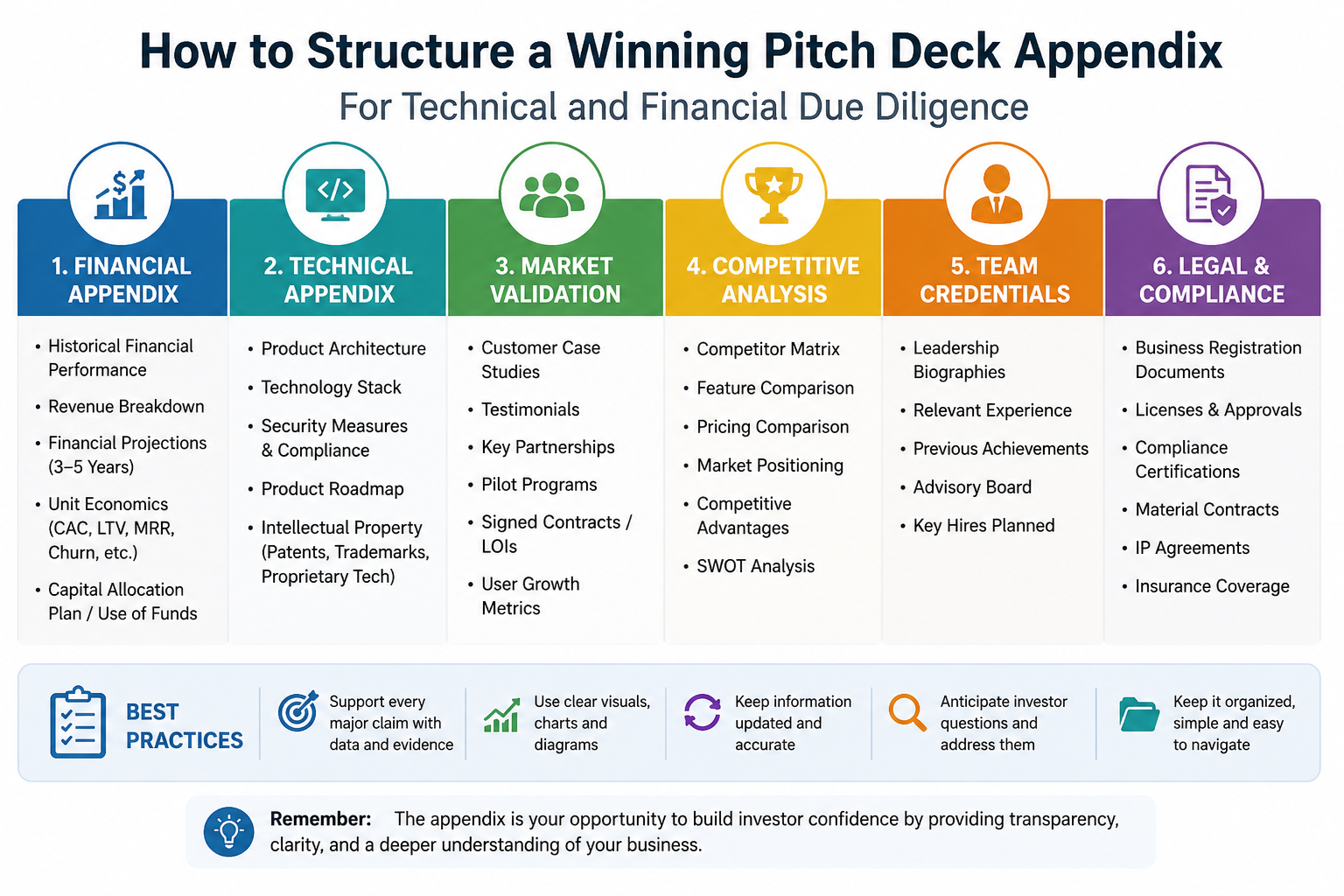
A compelling pitch deck can capture an investor’s attention in minutes, but securing funding often depends on what comes after the presentation. Once investors express interest, they typically begin a deeper review of your business through technical and financial due diligence. This is where a well-structured pitch deck appendix becomes invaluable.
An appendix isn’t meant to overwhelm investors with data. Instead, it serves as a repository of supporting information that validates your claims, answers deeper questions, and demonstrates that your business is built on solid fundamentals. A thoughtfully prepared appendix can increase investor confidence and help speed up the due diligence process.
What Is a Pitch Deck Appendix?
A pitch deck appendix is a collection of supplementary slides placed after your main presentation. While the core deck focuses on storytelling and high-level metrics, the appendix provides detailed information that investors can review if they want additional evidence.
Rather than crowding the main presentation with technical details or financial spreadsheets, the appendix allows founders to keep the pitch concise while still being fully prepared for investor questions.
Why the Appendix Matters During Due Diligence
Investors use due diligence to verify the accuracy of your claims and evaluate potential risks before making an investment. A comprehensive appendix demonstrates:
- Transparency
- Strong operational planning
- Financial discipline
- Technical credibility
- Market understanding
- Readiness for investment
Founders who can immediately provide supporting documentation often appear more organized and trustworthy.
Section 1: Financial Appendix
Financial information is one of the first areas investors examine. Include enough detail to support your projections without overwhelming readers.
Historical Financial Performance
Include:
- Revenue by year or quarter
- Gross profit
- Operating expenses
- EBITDA (if applicable)
- Net income
- Cash flow summary
Present this information using clear tables or charts.
Revenue Breakdown
Show how your business generates income.
Examples include:
- Product revenue
- Subscription revenue
- Enterprise customers
- Services
- Licensing
- Geographic distribution
This helps investors understand diversification and revenue concentration.
Financial Projections
Include forecasts for the next three to five years covering:
- Revenue
- Gross margin
- Operating expenses
- EBITDA
- Net profit
- Cash flow
Be prepared to explain the assumptions behind every forecast.
Unit Economics
Investors want to know whether your business model is sustainable.
Include metrics such as:
- Customer Acquisition Cost (CAC)
- Customer Lifetime Value (LTV)
- Gross Margin
- Payback Period
- Monthly Recurring Revenue (MRR)
- Annual Recurring Revenue (ARR)
- Churn Rate
These metrics help demonstrate the efficiency and scalability of your business.
Capital Allocation Plan
Explain exactly how new investment will be used.
Example:
- 40% Product Development
- 30% Sales & Marketing
- 15% Hiring
- 10% Infrastructure
- 5% Legal & Compliance
A clear use-of-funds plan reassures investors that capital will be deployed strategically.
Section 2: Technical Appendix
For technology startups, the technical appendix is often just as important as the financial section.
Product Architecture
Provide a simplified diagram showing:
- Front-end
- Back-end
- APIs
- Databases
- Cloud infrastructure
- Third-party integrations
Avoid overly technical jargon unless your audience consists of technical investors.
Technology Stack
List your core technologies, for example:
- Programming languages
- Frameworks
- Databases
- Cloud providers
- DevOps tools
- AI models (if applicable)
This demonstrates engineering maturity and scalability.
Security Measures
Investors increasingly evaluate cybersecurity risk.
Include information about:
- Data encryption
- Authentication methods
- Access controls
- Backup strategy
- Compliance certifications
- Disaster recovery planning
Security readiness is particularly important for fintech, healthcare, and SaaS companies.
Product Roadmap
Show upcoming development milestones, such as:
- New feature releases
- Platform expansion
- Mobile applications
- AI integrations
- Internationalization
- Enterprise capabilities
A roadmap demonstrates long-term product vision.
Intellectual Property
Include:
- Patents
- Patent applications
- Trademarks
- Proprietary algorithms
- Copyrights
- Trade secrets
Investors want to understand your competitive advantages and barriers to entry.
Section 3: Market Validation
Support your market claims with objective evidence.
Include:
- Customer case studies
- Testimonials
- Pilot programs
- Major partnerships
- Signed contracts
- Letters of intent
- User growth metrics
Real customer validation significantly strengthens investor confidence.
Section 4: Competitive Analysis
Expand beyond the simple comparison slide used in the main pitch.
Include:
- Detailed competitor matrix
- Feature comparison
- Pricing comparison
- Market positioning
- Competitive advantages
- SWOT analysis
This shows you’ve thoroughly researched your market landscape.
Section 5: Team Credentials
Investors often invest in founders as much as businesses.
Include:
- Leadership biographies
- Relevant industry experience
- Previous startup exits
- Technical expertise
- Advisory board members
- Key hires planned
Strong leadership reduces execution risk.
Section 6: Legal and Compliance
Depending on your industry, include:
- Business registrations
- Regulatory approvals
- Licenses
- Compliance certifications
- Insurance coverage
- Data privacy policies
- Material contracts
Addressing legal readiness early can prevent delays during due diligence.
Best Practices for a Strong Appendix
Keep It Organized
Use clear section headings and a logical flow so investors can quickly find the information they need.
Support Every Major Claim
If your main pitch states that customer retention is excellent, include detailed retention data in the appendix.
Use Visuals
Charts, graphs, diagrams, and dashboards communicate complex information more effectively than dense text.
Keep Information Updated
Outdated financials or product roadmaps can quickly undermine investor confidence. Review your appendix before every fundraising conversation.
Anticipate Questions
Think about the questions investors are most likely to ask and include supporting information before they ask for it.
Common Mistakes to Avoid
- Including excessive technical detail that distracts from key insights
- Using inconsistent financial figures between the main deck and appendix
- Presenting unrealistic projections without supporting assumptions
- Omitting customer validation
- Failing to explain key business metrics
- Providing outdated information
- Making the appendix difficult to navigate
Final Thoughts
A winning pitch deck appendix isn’t about adding more slides—it’s about providing the right evidence to support your story. While your main deck should inspire investors, the appendix should reassure them that your business is financially sound, technically robust, and ready for growth.
By organizing detailed financial metrics, technical documentation, market validation, competitive analysis, and legal information into a clear, professional appendix, founders can streamline due diligence, answer investor questions with confidence, and significantly improve their chances of securing funding.